Vacuum Oven vs Hot Air Oven: Which One Should Be Used for Sensitive Drying?
If the real concern is protecting samples (from oxidation, solvent “boiling over,” or heat damage) while still drying efficiently, the answer is usually simple: a vacuum oven is the safer tool for heat‑sensitive, solvent‑containing, or oxygen‑sensitive materials, while a hot air oven is best for robust items that tolerate higher temperatures and airflow.
I work with vacuum drying oven selection and application guidance. This page helps choose the right oven type, avoid common drying mistakes, and match capacity/specs to real workloads.
What is the real difference between a vacuum oven and a hot air oven?
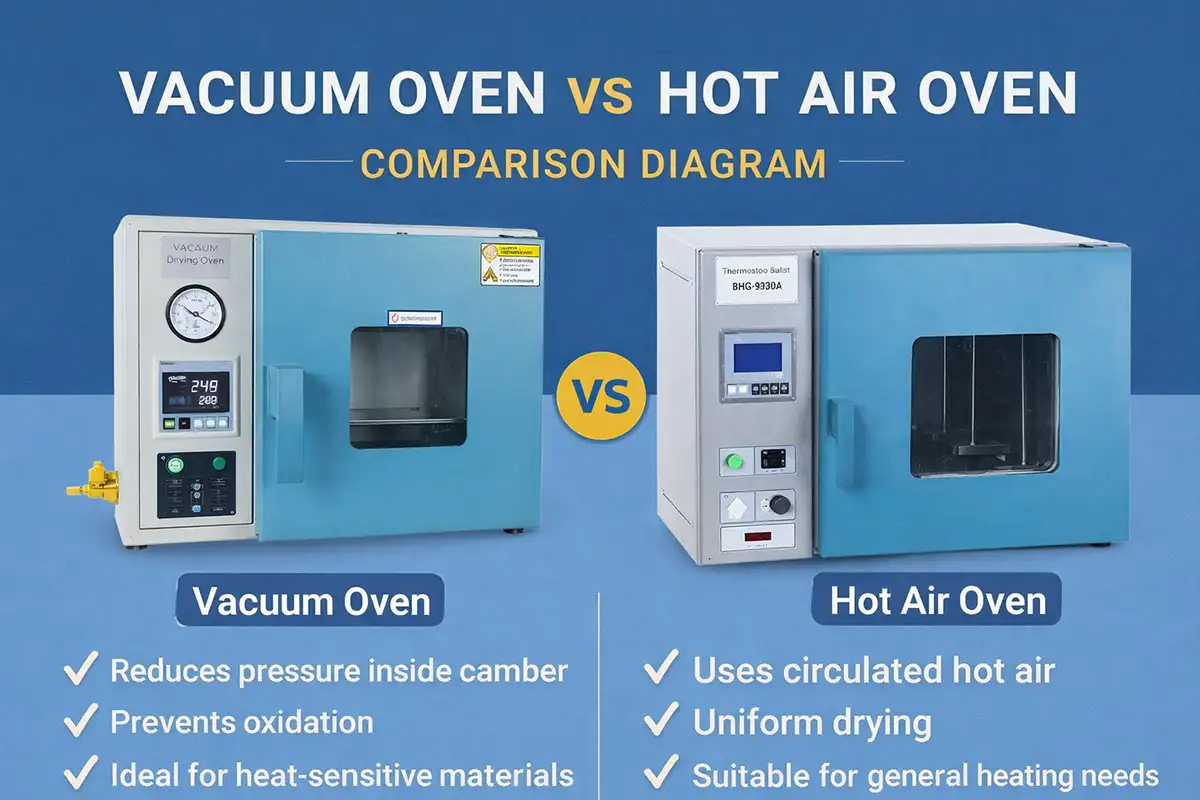
The difference is not “one is hotter than the other.” It’s how moisture (or solvent) leaves the material.
Hot air oven: uses heated air circulation at atmospheric pressure. Drying is driven by heat + airflow removing vapor. It’s simple and cost-effective for glassware, metal parts, and materials that tolerate higher temperatures and oxygen.
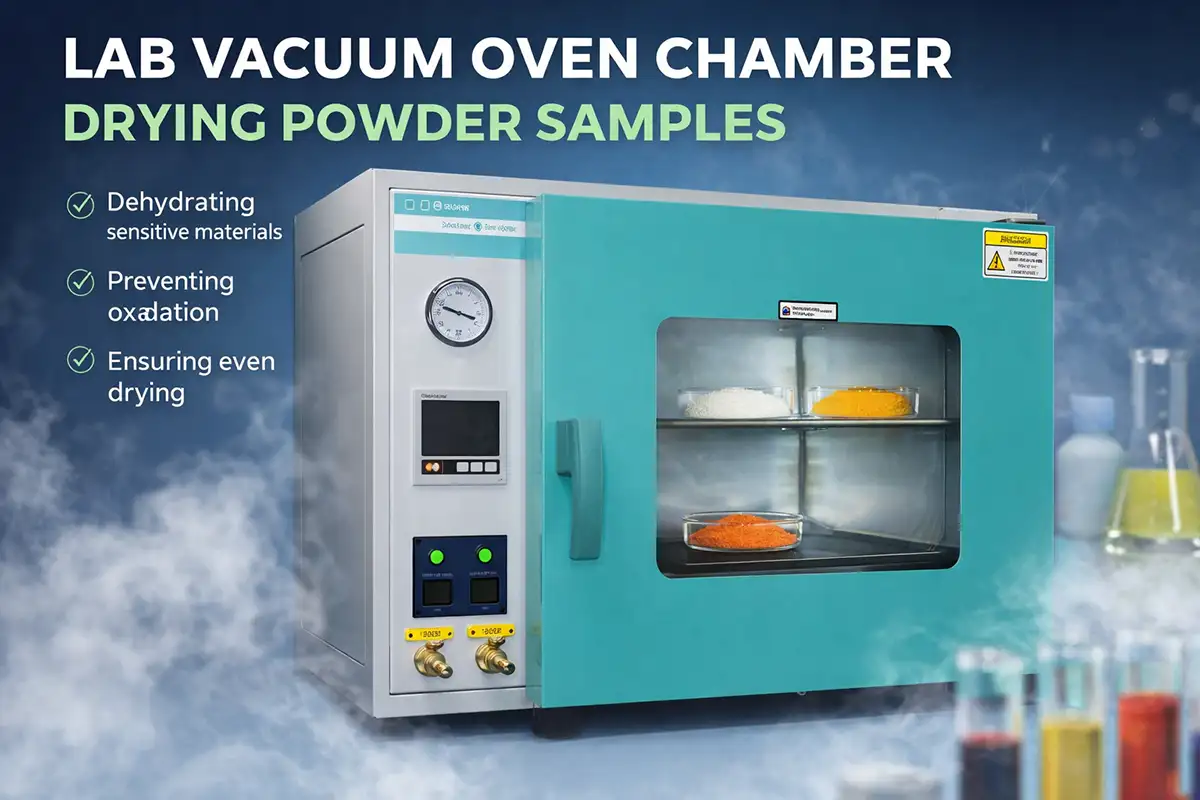
Vacuum oven: reduces pressure in the chamber, so liquids evaporate at lower temperatures. This is ideal for heat-sensitive powders, extracts, electronics, pharmaceuticals, polymers, and solvent-laden samples.
A widely accepted physical fact is that boiling point decreases as pressure decreases. For example, according toNIST (National Institute of Standards and Technology) reference data, the boiling point of water drops significantly under reduced pressure compared with standard atmospheric pressure—one of the main reasons vacuum drying can remove moisture gently rather than “baking” a sample.
Does vacuum drying always mean faster drying?
Not always. From my experience, it’s often faster for solvent-heavy or heat-sensitive materials because evaporation starts at a lower temperature. But for some rugged parts where aggressive airflow is the limiting factor, a hot air oven can be competitive. The key is identifying whether the bottleneck is temperature tolerance (favor vacuum) or convective airflow (hot air can win).
Choose a hot air oven when…
The material is thermally stable (no degradation, no melting, no discoloration).
Oxygen exposure is not a concern.
Drying is mainly surface moisture removal (e.g., glassware, tools, metal components).
Budget and simplicity are the top priority.
Practical note: if repeated batches show browning, cracking, or shrinking, it’s usually a sign the temperature/oxygen level is too harsh.
Choose a vacuum oven when…
The material is heat-sensitive (bio samples, APIs, polymers, coatings, adhesives).
There are solvents involved and lower-temperature evaporation is desired.
Oxidation causes quality loss (color shift, potency drop, brittleness).
Gentle, uniform drying is needed without strong airflow disturbing powders.
If the requirement includes risk control, an explosion-proof option can be relevant for certain solvent environments. For example, see an internal reference for an explosion-proof model:vacuum oven with pump / explosion-proof vacuum oven.
What if solvent odor or residue remains after hot air drying?
My answer: that’s a classic case for vacuum drying. Lower pressure encourages solvent removal without raising temperature to the point where the product oxidizes or “skins over.” The result is often cleaner drying and less trapped solvent.
A practical way to select a vacuum oven: match capacity + temperature + vacuum
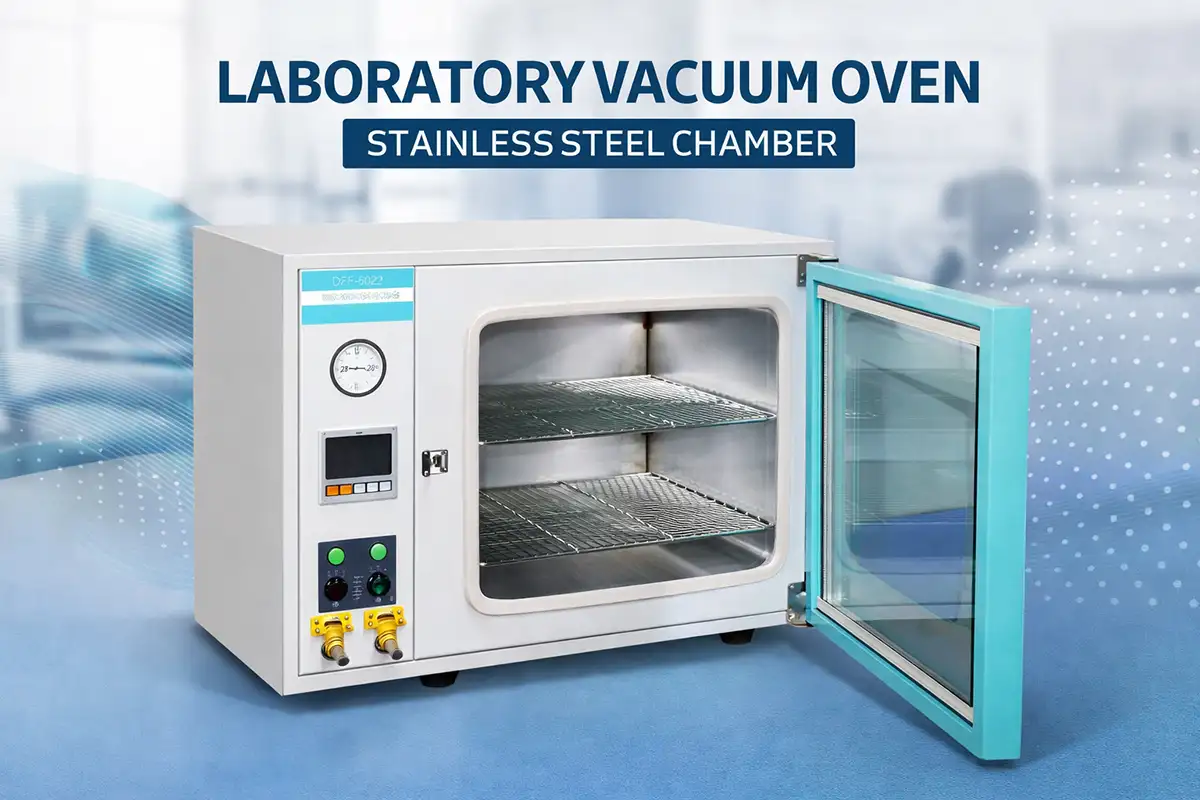
Below are real-world specs from a common DZF vacuum oven lineup, showing how capacity scales with power and shelf count. All models share a temperature range of RT+10~200°C and a max vacuum degree of 0.098 MPa, with 304 stainless steel chamber liners.
| Model | Capacity (L) | Inner Dimension (mm) | Shelves | Input Power (W) | Max Vacuum (MPa) | Temp Range (°C) |
|---|---|---|---|---|---|---|
| DZF-6010 | 8 | 200×200×200 | 1 | 400 | 0.098 | RT+10~200 |
| DZF-6020 | 25 | 300×280×300 | 1 | 800 | 0.098 | RT+10~200 |
| DZF-6050 | 55 | 400×400×345 | 2 | 1400 | 0.098 | RT+10~200 |
| DZF-6090 | 91 | 450×450×450 | 2 | 2400 | 0.098 | RT+10~200 |
| DZF-6210 | 215 | 560×600×640 | 3 | 2060 | 0.098 | RT+10~200 |
| DZF-6500 | 430 | 630×810×845 | 4 | 2800 | 0.098 | RT+10~200 |
Need a quick starting point? A benchtop unit is often enough for R&D and small batches:benchtop vacuum oven (DZF-6010). For larger loads, a higher-capacity chamber reduces batch splitting:large vacuum oven (DZF-6500).
Is a higher temperature always better for drying?
My answer: no. In many applications, higher temperature increases the risk of oxidation, warping, or loss of volatiles. Vacuum drying is popular precisely because it can achieve drying targets at lower thermal stress. Temperature should be set based on the material’s safe limit, not just on speed.
The science-backed reason vacuum ovens protect quality
Drying under reduced pressure changes phase-change behavior. In practice, this means less overheating and less oxidation risk. This is aligned with standard reference guidance used across labs and industry. For broad, authoritative background on vacuum technology and applications, see the educational resources from theAmerican Vacuum Society (AVS), a leading professional organization in vacuum science.
The takeaway is simple: when product quality depends on gentle drying, a vacuum oven is not just “another oven”—it is a process control upgrade.
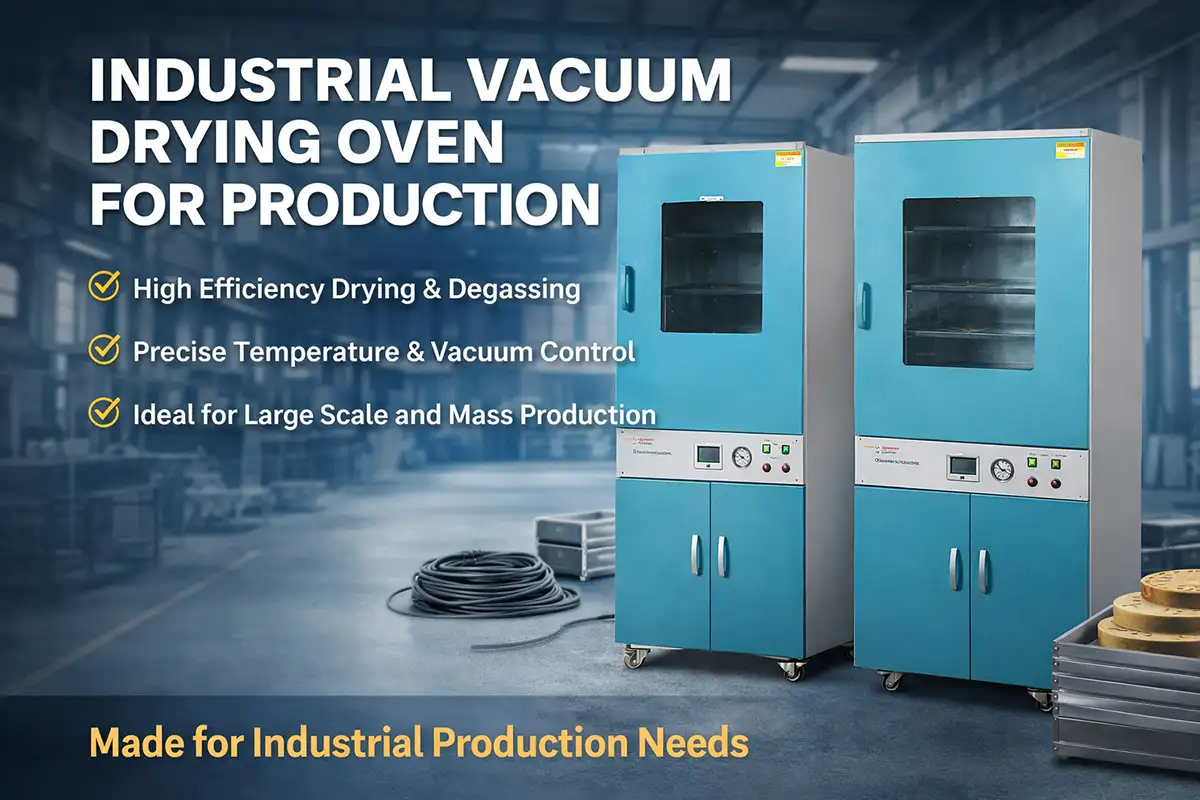
Final answer: vacuum oven vs hot air oven—what should be chosen?
If drying is routine and the product is tough, a hot air oven can be enough. But if there is any sign of degradation, oxidation, solvent retention, or powder disturbance, a vacuum oven is usually the correct choice. That’s why vacuum ovens are widely used in labs and production lines for sensitive materials.
For model selection, focus on three numbers: capacity (batch size), temperature range (process window), and achievable vacuum (how low the pressure can go). The DZF lineup shown above covers 8 L to 430 L, up to 200°C, and up to 0.098 MPa max vacuum degree.